Age verification
Are you 21 or older?
This site features cannabis products. Please confirm your age before entering.
Age verification
This site features cannabis products. Please confirm your age before entering.
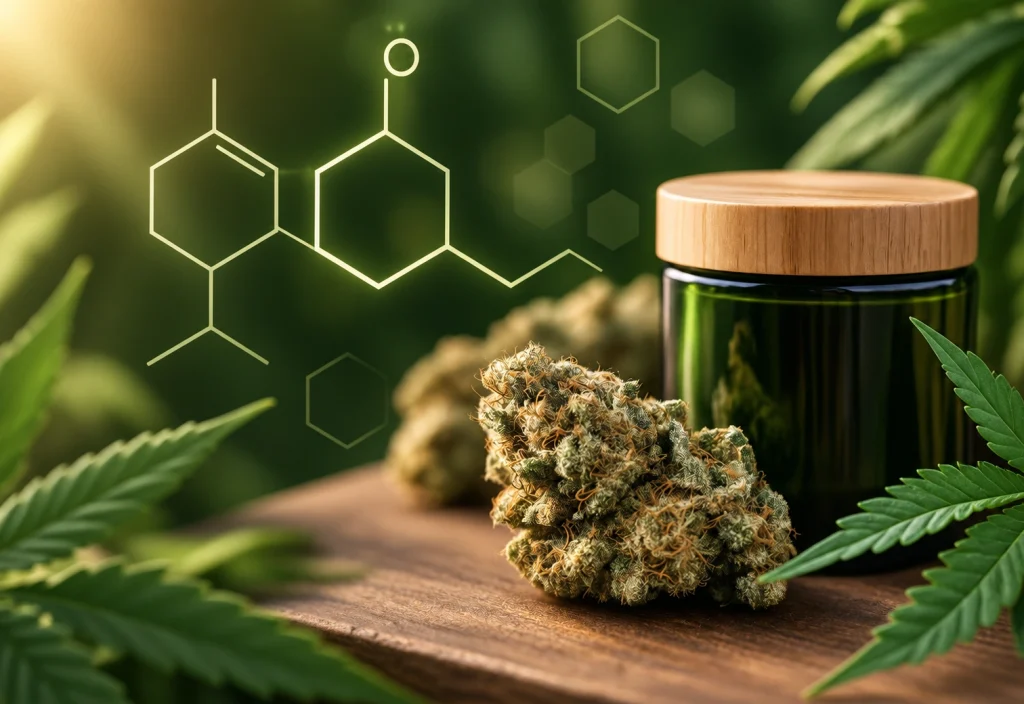
Cannabis contains more than 100 naturally occurring cannabinoids, and while THC and CBD are the most familiar, cannabinol (CBN) is another cannabinoid that has attracted growing interest. CBN is considered a minor cannabinoid, meaning it is generally found in much smaller amounts than THC and CBD. Researchers are studying CBN to better understand how it interacts with the body’s endocannabinoid system and what effects it may have. (PubMed Central (PMC))
CBN stands for cannabinol. Unlike THC, which is produced directly by the cannabis plant in its acidic form and converted into THC through heat or aging, CBN is primarily formed when Δ9-THC undergoes oxidation and degradation. Exposure to factors such as oxygen, light, heat, and time can contribute to the conversion of THC into CBN. (PubMed Central (PMC))
This is why CBN is often associated with older or aged cannabis. However, the idea that simply having more CBN automatically means cannabis will produce a stronger sleepy or relaxing effect is not established by current human research. (PubMed Central (PMC))
Although CBN, THC, and CBD are all cannabinoids, they have different chemical and pharmacological profiles.
THC (tetrahydrocannabinol) is the primary intoxicating cannabinoid in cannabis. It interacts strongly with CB1 receptors in the endocannabinoid system and is responsible for much of the characteristic “high” associated with cannabis. (PubMed Central (PMC))
CBD (cannabidiol) does not produce the same intoxicating effects as THC. It has relatively low direct affinity for the classic CB1 and CB2 cannabinoid receptors and interacts with several other biological pathways. (PubMed Central (PMC))
CBN (cannabinol) has a weaker interaction with CB1 receptors than THC. Human research generally suggests that CBN does not produce the same cannabis-like intoxication associated with THC, although describing it simply as completely “non-psychoactive” can oversimplify the available evidence. (PubMed Central (PMC))
| Cannabinoid | Full Name | General Characteristics |
|---|---|---|
| THC | Tetrahydrocannabinol | Primary intoxicating cannabinoid |
| CBD | Cannabidiol | Non-intoxicating; interacts with several biological pathways |
| CBN | Cannabinol | Minor cannabinoid, largely formed through THC degradation |
One of the biggest reasons CBN has become popular is its reputation as the “sleep cannabinoid.” CBN products are commonly marketed toward people looking for relaxation or nighttime products.
However, it is important to separate marketing claims from scientific evidence.
Earlier research on CBN and sleep was limited, with many studies being small, old, or conducted in animals. A review specifically examining CBN and sleep found that there was not enough high-quality human evidence to establish that CBN itself reliably improves sleep. (PubMed Central (PMC))
More recent research has continued to investigate CBN-containing formulations, including combinations with other cannabinoids. A 2026 systematic review of medical cannabis for insomnia included studies involving CBN, CBD, and THC, but the evidence across cannabinoid formulations remains varied and does not mean that CBN should automatically be considered a proven sleep treatment. (PubMed)
So, while CBN is interesting for sleep research, stronger clinical evidence is still needed.
Scientists are investigating CBN for several potential applications, including sleep, pain, inflammation, appetite, and other biological effects. Much of the research is still preclinical, meaning it comes from laboratory or animal studies rather than large human clinical trials. (PubMed Central (PMC))
For example, laboratory and animal studies have suggested that CBN may interact with cannabinoid receptors and other biological pathways involved in pain, inflammation, and nervous-system activity. These findings can help researchers identify areas worth studying, but they do not by themselves prove that CBN will produce the same effects in people. (PubMed Central (PMC))
Current clinical evidence remains limited. A 2026 review of the evidence surrounding CBN concluded that evidence for clinical applications remains insufficient for firm recommendations. (PubMed)
CBN is generally considered to have much weaker intoxicating effects than THC. Older human studies found little evidence of THC-like intoxication from CBN alone, although research has been limited and has often involved small numbers of participants. (PubMed Central (PMC))
That distinction is important when comparing CBN products with THC products. CBN should not simply be treated as another form of THC, even though CBN can be produced as THC breaks down.
CBN is increasingly appearing in products such as:
Oils and tinctures
Capsules
Edibles
Vape products
Topical products
Cannabis products containing combinations of CBN, CBD, and THC
Its popularity is largely connected to interest in minor cannabinoids and products marketed for nighttime use and relaxation.
As with any cannabis product, the experience can depend on the cannabinoid profile, dosage, method of consumption, individual factors, and whether other cannabinoids or compounds are present.
CBN is an interesting cannabinoid with a growing body of research behind it, but it is important to keep expectations realistic.
What we know:
CBN is a naturally occurring cannabinoid associated with cannabis.
It can form as THC undergoes oxidation and degradation.
It interacts with the endocannabinoid system.
Its effects are generally much weaker than THC’s intoxicating effects.
Researchers are actively studying its potential biological effects. (PubMed Central (PMC))
What we’re still learning:
How CBN affects sleep in different people.
Which doses and formulations may have meaningful effects.
How CBN interacts with THC, CBD, and other cannabinoids.
Its long-term effects and safety profile.
Which potential uses can ultimately be supported by strong human clinical evidence. (PubMed)
CBN, or cannabinol, is a minor cannabinoid that has become increasingly popular as researchers and consumers look beyond THC and CBD. Its connection to aged cannabis and its potential role in relaxation and sleep have made it particularly interesting, but many of the claims surrounding CBN are ahead of the scientific evidence.