Age verification
Are you 21 or older?
This site features cannabis products. Please confirm your age before entering.
Age verification
This site features cannabis products. Please confirm your age before entering.
Cannabinoids are natural chemical compounds found in the cannabis plant. These compounds interact with a system in the human body called the endocannabinoid system (ECS), which helps regulate processes such as mood, sleep, appetite, memory, and overall balance.
Different cannabinoids can interact with the body in different ways. This is why cannabis products may produce experiences that feel relaxing, uplifting, calming, or balancing depending on their cannabinoid profile.
Your body naturally produces its own cannabinoids, called endocannabinoids. These compounds are part of the endocannabinoid system, a network involved in maintaining balance within the body.
The ECS includes:
CB1 receptors – Found primarily in the brain and central nervous system and involved in processes such as mood, memory, appetite, and perception.
CB2 receptors – Found mainly in immune cells and various tissues throughout the body and are involved in immune-system activity.
Cannabinoids from the cannabis plant, known as phytocannabinoids, can interact with the ECS in different ways. These interactions contribute to the effects associated with different cannabis products.
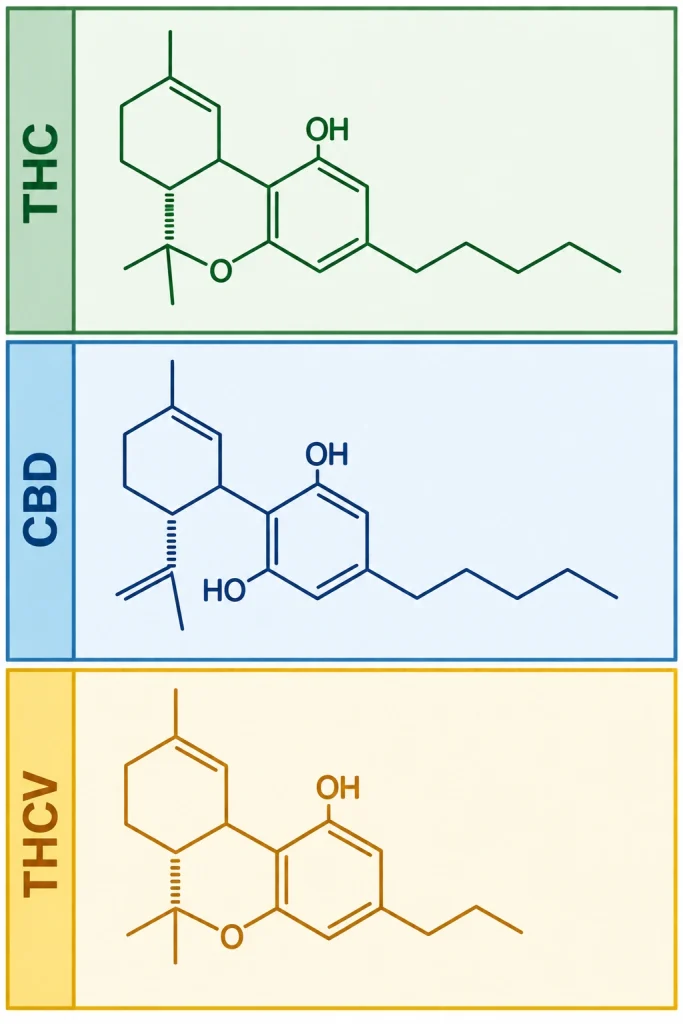
THC is the primary psychoactive cannabinoid found in many cannabis varieties.
It is responsible for the intoxicating effects commonly described as the cannabis “high.” Depending on the product, dose, and individual, THC may be associated with:
Relaxation
Euphoria
Changes in perception
Increased appetite
Feelings of creativity or altered thinking
Drowsiness, particularly at higher doses
Because THC is intoxicating, understanding the amount of THC in a product can help consumers make more informed choices.
CBD is a non-intoxicating cannabinoid, meaning it does not produce the traditional cannabis “high” associated with THC.
CBD is commonly found in wellness-focused cannabis and hemp products and is often associated with feelings of calm and balance.
Unlike THC, CBD does not typically produce significant changes in perception or consciousness. Its effects can vary depending on the individual, product formulation, and amount consumed.
THC and CBD may be the most widely recognized cannabinoids, but cannabis contains many other cannabinoids that occur in smaller amounts. These are often referred to as minor cannabinoids.
Some notable examples include:
CBG is a minor cannabinoid that has attracted interest for its potential wellness applications.
It is sometimes associated with feelings of focus and balance, although research into its effects is still developing.
CBN is another minor cannabinoid that is commonly associated with relaxation and nighttime products.
While CBN is often marketed in products designed for sleep or relaxation, research into its effects on sleep is still ongoing.
CBC is a less commonly discussed cannabinoid that occurs naturally in cannabis.
Research has explored its potential interactions with biological pathways involved in mood, comfort, and overall wellness, although more research is needed to understand its effects in humans.
THCV is a minor cannabinoid that is structurally similar to THC but has a different pharmacological profile.
It has attracted research interest because of its distinct interactions with the body’s cannabinoid receptors and its potential wellness applications.
THCV can be found naturally in certain cannabis varieties, generally in smaller concentrations than THC or CBD.
These minor cannabinoids are an active area of research, and their effects can vary depending on concentration, product formulation, and individual response.
Cannabinoids don’t necessarily work in isolation. Cannabis contains a variety of compounds, including cannabinoids and terpenes, that may interact with one another.
This concept is commonly referred to as the “entourage effect.”
Terpenes are aromatic compounds found in cannabis and many other plants. They contribute to the aroma and flavor of cannabis and are being studied for their potential interactions with cannabinoids.
The idea behind the entourage effect is that combinations of cannabinoids and other cannabis compounds may produce an experience that differs from using an individual compound alone.
This is one reason full-spectrum cannabis products are often described as providing a more comprehensive cannabinoid and terpene profile.
However, research into the entourage effect is still developing, and the exact nature and significance of these interactions are not yet fully established.
Understanding cannabinoids can help you better understand what’s in a cannabis product and how different formulations may produce different experiences.
Learning about cannabinoid profiles can help you:
Choose products more thoughtfully based on their cannabinoid content
Understand potency and intensity by paying attention to THC and other cannabinoid levels
Compare different product types and formulations
Make more informed cannabis decisions
Use cannabis more responsibly by understanding the compounds you’re consuming
Remember that everyone’s response to cannabis can be different. Effects can depend on factors such as cannabinoid concentration, dosage, product type, individual tolerance, and how the product is consumed.
Cannabinoids are an important part of what makes cannabis unique. THC and CBD are the most familiar, but minor cannabinoids such as CBG, CBN, CBC, and THCV are also gaining attention.
By understanding the differences between these compounds—and how they may interact with terpenes and the endocannabinoid system—you can become more informed about the cannabis products you choose.
As research continues, our understanding of cannabinoids and their potential effects will continue to evolve.