Age verification
Are you 21 or older?
This site features cannabis products. Please confirm your age before entering.
Age verification
This site features cannabis products. Please confirm your age before entering.
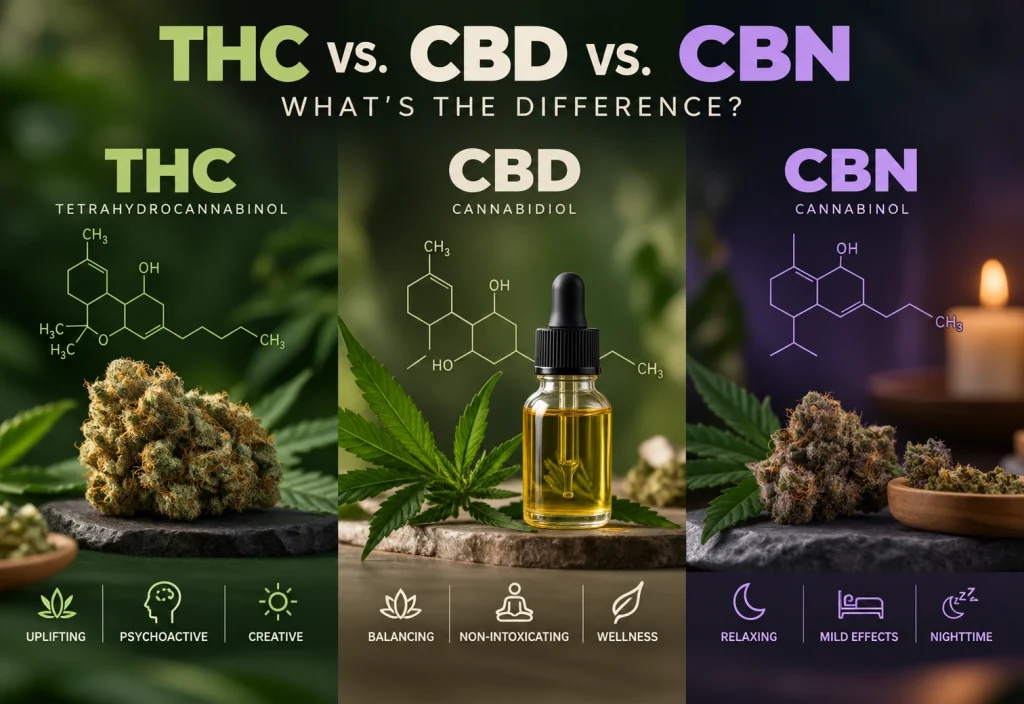
Cannabis contains many naturally occurring cannabinoids, but THC, CBD, and CBN are three that consumers are likely to encounter most often. Although they come from the same plant, they have different chemical properties, interact with the body in different ways, and are commonly associated with different types of cannabis products.
Understanding the differences can make it easier to read product labels and understand what you’re buying.
Cannabinoids are chemical compounds that interact with the body’s endocannabinoid system and other biological pathways. Cannabis contains many cannabinoids, with THC and CBD being the most widely recognized. CBN is considered a minor cannabinoid because it is typically present in much smaller amounts.
The three compounds are chemically related, but their effects and interactions are not identical.
THC, or delta-9-tetrahydrocannabinol, is the cannabinoid most closely associated with the traditional cannabis “high.”
THC interacts with cannabinoid receptors, particularly CB1 receptors in the brain and nervous system. This interaction is responsible for many of the intoxicating effects associated with cannabis.
Depending on the product and individual, THC can be associated with changes in perception, mood, coordination, attention, and memory. The intensity of the experience can vary considerably depending on factors such as dose, product potency, consumption method, and individual tolerance.
Dried cannabis flower
Pre-rolls
Vapes
Concentrates
Edibles
Oils and capsules
Beverages
THC is generally the cannabinoid to pay the most attention to when considering intoxication and impairment.
CBD, or cannabidiol, is another major cannabinoid found in cannabis.
Unlike THC, CBD is not generally considered intoxicating and does not produce the same “high” associated with THC. CBD interacts with the body’s biological systems differently from THC and has relatively low direct affinity for the traditional CB1 and CB2 cannabinoid receptors.
CBD has attracted considerable scientific interest, although many claims made about consumer CBD products go beyond what clinical research currently establishes.
The FDA notes that CBD can have potential risks, including drug interactions and liver injury, and has approved a purified CBD prescription medication for specific seizure disorders. This approval should not be interpreted as approval of CBD products generally.
Oils and tinctures
Capsules
Edibles
Topicals
Vapes
Cannabis flower
CBD-dominant products
CBN, or cannabinol, is a minor cannabinoid that is particularly interesting because of its relationship with THC.
CBN can form as THC undergoes oxidation and degradation, with exposure to factors such as oxygen, light, heat, and time contributing to this process. As a result, CBN is often associated with aged cannabis.
CBN interacts with cannabinoid receptors, but its interaction with CB1 is weaker than THC’s, which helps explain why it does not produce the same level of intoxicating effects as THC.
CBN is particularly popular in products marketed for nighttime use, relaxation, and sleep, but the scientific evidence supporting CBN as a sleep aid is still limited. Current reviews emphasize that more human research is needed.
Oils and tinctures
Capsules
Edibles
Vapes
Topical products
Formulations combining CBN with CBD or THC
| Feature | THC | CBD | CBN |
|---|---|---|---|
| Full name | Delta-9-tetrahydrocannabinol | Cannabidiol | Cannabinol |
| Cannabinoid type | Major cannabinoid | Major cannabinoid | Minor cannabinoid |
| Intoxicating? | Yes | Generally no | Much less intoxicating than THC |
| Relationship to THC | Primary intoxicating cannabinoid | Separate cannabinoid | Can form as THC degrades |
| Commonly discussed for | Cannabis intoxication and recreational effects | Wellness and research into potential therapeutic applications | Nighttime products and relaxation |
| Common products | Flower, vapes, edibles, concentrates | Oils, edibles, topicals, capsules | Oils, edibles, capsules, vapes |
| Research status | Extensive research | Extensive and ongoing research | More limited research |
The table describes general scientific characteristics, not guaranteed effects from a particular product.
Cannabis products don’t always contain just one cannabinoid.
A product may contain THC and CBD, CBD and CBN, or a combination of all three. This means the experience associated with a product depends on its overall cannabinoid profile, rather than simply the presence of one compound.
For example, a product containing CBN and THC should not necessarily be considered equivalent to a CBN-only product. The amount of THC can substantially change the product’s intoxicating effects.
This is why checking the cannabinoid content and potency on the product label is important.
You may have heard the term “entourage effect.”
This refers to the idea that cannabinoids and other cannabis compounds may interact with one another and produce effects that differ from those of individual compounds alone.
Researchers continue to investigate these interactions, including how cannabinoids may interact with terpenes and other cannabis compounds. However, the exact extent and clinical significance of these interactions remain an active area of research.
It’s therefore better to view the entourage effect as a scientific hypothesis under investigation, rather than a guaranteed effect of every cannabis product.
There isn’t a single cannabinoid that is universally “best.” THC, CBD, and CBN have different properties, and the appropriate choice depends on the product, intended use, personal circumstances, and local regulations.
A simple way to think about them is:
THC → Intoxicating cannabis effects
CBD → Non-intoxicating cannabinoid with broad research interest
CBN → Minor cannabinoid often associated with nighttime products and ongoing sleep research
Most importantly, marketing language shouldn’t be confused with established scientific evidence. CBN, in particular, is still being studied, and current evidence isn’t strong enough to make definitive claims about its ability to treat sleep problems or other medical conditions.
THC, CBD, and CBN are three different cannabinoids with distinct properties.
THC is primarily known for its intoxicating effects. CBD is generally non-intoxicating and has been extensively studied, including as the active ingredient in an approved prescription medication for certain seizure disorders. CBN is a minor cannabinoid that can develop as THC degrades and is receiving increasing research attention, particularly around sleep and relaxation.
As research continues, our understanding of these cannabinoids will become clearer. For consumers, the best starting point is to understand the cannabinoid profile, check the product label, and distinguish established evidence from marketing claims.